Posted on Leave a comment

ISO 17025 vs ISO 9001: Key Differences and Decision Guide

ISO 17025 vs ISO 9001 key differences decision guide illustration

ISO 9001 shows that your quality management system is controlled. ISO 17025 vs ISO 9001 is really a choice between process consistency and defensible measurement results. This guide breaks down scope, outputs, audit depth, and the evidence trail so you can pick the right anchor and avoid duplicate systems.

  1. If you are a testing or calibration lab issuing results that customers rely on, choose ISO/IEC 17025.
  2. If you are a non-lab organisation needing consistent processes, choose ISO 9001.
  3. If you are both: build one system, then layer lab technical controls.

Quick Decision

Start with what you deliver. That output decides which standard carries the weight.

If your lab issues results that customers use for acceptance, compliance, release, or dispute defense, ISO/IEC 17025 is the right anchor. If you primarily need consistent processes, supplier confidence, and organisation-wide control, ISO 9001 is the right anchor.

A clean way to decide is to match the standard to the risk you must control.

  • If the risk is “our process is inconsistent,” ISO 9001 is the backbone.
  • If the risk is “our measurement is questioned,” ISO/IEC 17025 is the backbone.
  • If both risks exist, build one system, then layer lab technical controls.

That decision prevents the most common failure mode, which is duplicate documents with weak evidence behind the results.

Option A vs Option B 

Option A: Build around ISO 9001 first
Choose this when your biggest failure mode is inconsistent delivery across departments, and lab results are not used as technical proof near limits.

Option B: Build around ISO/IEC 17025 first
Choose this when your biggest failure mode is disputed measurement, customer complaints on results, or acceptance decisions that depend on uncertainty and traceability.

Trust Anchors 

ISO’s annual survey reports 1,265,216 valid ISO 9001:2015 certificates covering 1,666,172 sites for 2022. ISO

ILAC reports over 114,600 laboratories accredited by ILAC MRA Signatories in 2024. (ILAC – ILAC Live Site)

What Each Standard Proves

ISO 9001 proves that an organisation runs a controlled quality management system. It is designed to make work repeatable, measurable, and improvable. You get stronger process discipline, clearer responsibility, and better control of nonconformities across departments.

ISO/IEC 17025 proves that a laboratory can produce valid results for defined activities. The difference is not the paperwork volume. The difference is the technical defensibility of a result.

That defensibility is built from method control, competence, equipment control, metrological traceability, measurement uncertainty, where applicable, technical records, and validity monitoring.

A simple way to remember the boundary is this: ISO 9001 improves how you run work. ISO/IEC 17025 improves how you defend results.

Certification And Accreditation

ISO 9001 is typically evaluated through certification audits. The audit checks whether your management system meets the requirements and whether you follow your own controls consistently.

ISO/IEC 17025 is typically evaluated through accreditation assessments, where competence is judged against your scope. The assessment does not stop at procedure statements. It drills into method use, records, calculations, and how the lab controls validity over time.

That difference is why ISO 9001 can feel “system-heavy,” while ISO/IEC 17025 feels “evidence-heavy.” Labs often underestimate this gap and only realise it during a technical witness or a deep dive into records.

How To State Compliance Correctly

ISO 9001: Certified (your management system meets requirements and is consistently controlled).

ISO/IEC 17025: Accredited (your technical competence is proven to a defined scope of tests/calibrations).

If your market language blurs these two, you attract avoidable disputes. Customers interpret “certified” and “accredited” very differently when a result is challenged.

Where ISO 9001 Maps Into ISO/IEC 17025 

This is not a one-to-one clause match. It is a practical alignment, so you reuse what matters without weakening lab evidence.

ISO 9001 themeWhere it lands in ISO/IEC 17025What to carry over (without dilution)
Process control and documented informationClause 8 (Management system)Document control, change control, internal audits, and  management review
Competence and trainingClause 6 (Resources)Competence criteria, authorisation, training effectiveness evidence
Equipment and calibration controlClause 6 + Clause 7Equipment control that closes the traceability chain
Nonconformity and corrective actionClause 8.7Root cause, correction, and effectiveness check tied to the result risk
Monitoring, measurement, improvementClause 7 + Clause 8.6Validity monitoring signals, trend reviews, and improvement actions

ISO 17025 vs ISO 9001 Comparison Table

Decision PointISO 9001 emphasisISO/IEC 17025 emphasisWhat it means in practice
ScopeOrganisation-wide QMSDefined lab scopeYour scope must match outputs
PromiseProcess consistencyResult validityResults must be defensible
RecognitionCertificationAccreditationCompetence is assessed in scope
MethodsControlled processesMethod suitabilityMethod control drives credibility
TraceabilityCalibration controlMetrological traceabilityThe traceability chain must close
UncertaintyNot centralCore where applicableDecisions must reflect uncertainty
Technical recordsControlled recordsTechnical recordsAnother person can recreate the result
Validity monitoringKPI reviewsValidity monitoringDrift detection becomes mandatory thinking

Evidence That Makes Results Defensible

Most weak implementations fail in the same place. The system looks fine, but the evidence behind the results is thin. ISO/IEC 17025 demands a technical evidence trail that can reproduce a reported result without guesswork.

A lab-ready evidence trail has three layers that must align.

Layer one is management control. Layer two is technical control. Layer three is result defense. When these layers disagree, audits become painful, and customer confidence drops fast.

The most important evidence to get right is predictable.

  • Technical records that recreate the full result path.
  • Metrological traceability proof that closes without gaps.
  • Measurement uncertainty logic tied to decision impact.
  • Validity monitoring that catches drift early.
  • Reporting controls that prevent silent template errors.

Once these are stable, the rest of the system stops feeling heavy. Work becomes calmer because every output can be defended.

What Assessors Actually Test 

Measurement uncertainty is not a mathematical ornament. It is a decision input. If your acceptance limit is tight, uncertainty changes the risk of a wrong accept or a wrong reject. That is why strong labs link uncertainty to decision rules rather than keeping it as a standalone calculation.

Micro-example:
A customer uses a calibration certificate to accept a gauge near a spec limit. Your measured value is barely inside tolerance, but the stated uncertainty overlaps the limit.

If your report makes a “pass” claim without a clear decision rule, you have created a dispute risk. A good ISO/IEC 17025 system forces you to show how uncertainty impacts conformity at the limit, and what rule you used to make the claim.

Metrological traceability is not “we calibrated the instrument.” Traceability is a documented chain that connects your measurement to reference standards with known uncertainty at each step. Break the chain, and the result becomes an opinion.

Validity monitoring is not “we do internal QC sometimes.” Validity monitoring is planned evidence that your method stays in control over time. Control samples, intermediate checks, replicate trends, or proficiency comparisons are typical tools, but the key is the logic: detect drift before customers do.

Audit Differences ISO 17025 vs ISO 9001

ISO 9001 audits usually confirm system conformance and consistency. Sampling focuses on whether processes are followed, records exist, actions are closed, and improvement cycles run.

ISO/IEC 17025 assessments and audits go further into technical proof. A single issued result can trigger a deep record trail review, including raw data integrity, calculation correctness, equipment suitability on the day, environmental suitability, method usage, traceability chain, and uncertainty decision impact.

This is where the “ISO 17025 audit” behaves differently than people expect. The assessor is not only checking that you have a system. The assessor is checking that your reported result is defensible.

An “ISO 17025 internal audit” should mirror that reality. The strongest internal audits are report-trail audits. One report is selected, then every critical statement is traced back to objective evidence, and then forward again to the issued decision. This turns internal audit into a competence test, not a paperwork review.

Result Defensibility Stress Test

Most competitor pages do not give you a sharp self-check. Use this test on any single report or certificate before you trust it.

Ask five questions.

  1. Can another competent person recreate the result from technical records alone?
  2. Can you show a complete metrological traceability chain for the critical measurement?
  3. Would measurement uncertainty change the accept or reject decision at the limit?
  4. Was the method suitable for the sample and range used that day?
  5. Do you have validity monitoring evidence that drift is controlled?

A “no” to any one question is not a small gap. It is a credibility gap.

FAQ

1. Is ISO 17025 the same as ISO 9001?

No. ISO 9001 is a general quality management system standard. ISO/IEC 17025 is a laboratory competence standard tied to the technical validity of results.

2. Do labs need ISO 9001 before ISO/IEC 17025?

No. ISO 9001 can strengthen management controls, but ISO/IEC 17025 stands on its own when your goal is defensible lab results.

3. What is accreditation compared to certification?

Certification confirms a management system meets requirements. Accreditation evaluates technical competence to a defined scope.

4. What does ISO/IEC 17025 check that ISO 9001 does not?

It checks the technical validity behind results, including traceability, uncertainty impact, technical records, method control, and ongoing validity monitoring.

5. Which is better for a lab: ISO 17025 vs ISO 9001?

Choose ISO/IEC 17025 when customers rely on your measurement results. Choose ISO 9001 when you need organisation-wide process consistency. Use both only when you control duplication by design.

Conclusion

ISO 9001 and ISO/IEC 17025 solve different failure modes. ISO 9001 stabilises how work is run across an organisation. ISO/IEC 17025 stabilises whether a reported result can be defended under technical scrutiny.

The decision becomes clear when you look at outputs. If your customers depend on your test report or calibration certificate, you need the evidence depth that ISO/IEC 17025 enforces.

If your core risk is inconsistent processes, ISO 9001 gives the control structure. When both risks exist, one integrated system with a strong technical evidence trail beats two parallel systems every time.
Posted on Leave a comment

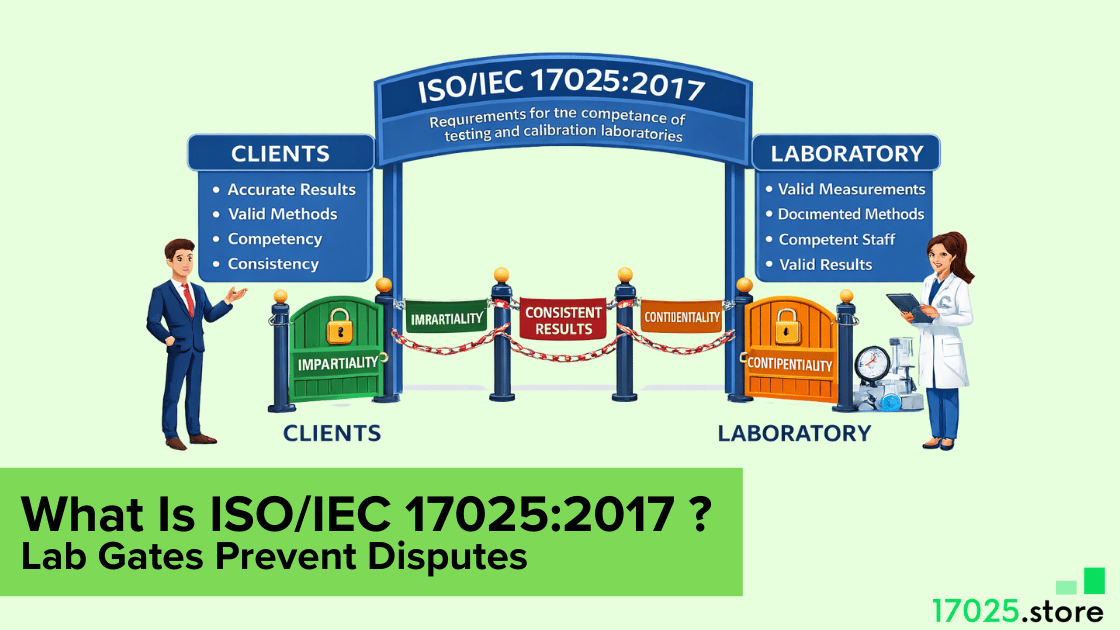
What Is ISO/IEC 17025:2017? Lab Gates Prevent Disputes

ISO/IEC 17025:2017 lab gates prevent disputes between clients and laboratories

What Is ISO/IEC 17025:2017

Customer disputes start when results cannot be reconstructed. Regulators challenge labs when the scope is unclear. Product failures expose weak records and weak controls. ISO/IEC 17025:2017 exists for these moments. You will learn what the standard controls are, how accreditation decisions hold up, and which lab gates prevent avoidable findings.

Why Labs Ask What Is ISO 17025

Customer pressure often arrives after the report is issued. A complaint starts, then evidence is demanded. Confidence collapses when records do not link. Scope mismatch is a common trigger.

When teams ask What is ISO 17025 is, they want confidence in accuracy. They also want repeatability across operators and shifts. The standard answers that need controls. Those controls tie work to competence, methods, and records.

A lab can look organized and still be weak. The gap shows up in the traceability of decisions. Another gap shows up in the report statements. A third gap is uncontrolled method changes.

What It Controls In Daily Work

The standard rewards labs that control production, not paper. That means you control what you accept, what you do, and what you release. Control starts before the job begins. Control ends after the result is defended.

Weak labs rely on trust and memory. Strong labs rely on gates and records. Gates stop bad work early. Records let you defend good work later.

Control Gates That Prevent Bad Reports

Control GateWhat Must Be TrueWhat Breaks When It Fails
Contract ReviewMethod fit and scope fit are confirmedWrong method or out-of-scope work
Method ControlVerification or validation is triggered when neededResults drift after changes
Equipment StatusCalibration and intermediate checks are enforcedHidden equipment bias persists
Technical RecordsRaw data, calculations, and review trail are linkedResults cannot be reconstructed
Validity MonitoringTrends, checks, and PT or ILC are usedDrift stays invisible
ReportingRequired statements are present, and limits are clearReports mislead customers

These gates are small, but they scale. They also match what assessors test. Most disputes map back to one failed gate.

Clause 7 Process Spine

Clause 7 is the process backbone in ISO/IEC 17025:2017.

  • This is where labs win or fail.
  • The spine defines the technical flow.
  • It also defines what proof must exist.

7.1 Contract Review Control

7.2 Method Selection, Verification, Validation

7.3 Sampling, If Applicable

7.4 Handling Of Items

7.5 Technical Records

7.6 Uncertainty Evaluation, Where Relevant

7.7 Validity Monitoring

7.8 Reporting Requirements

7.9 Complaints

7.10 Nonconforming Work

7.11 Data And Information Management

Run this spine like a production line. Each step needs a trigger and a record. Each step needs ownership and review. Gaps compound across steps.

How ISO 17025 Accreditation Works

A report can be accepted or rejected on scope alone. Accreditation is not a general claim. It is a competence decision tied to scope. Scope defines what you can defend.

In ISO 17025 Accreditation, the scope is the deliverable. It ties methods to ranges and conditions. It also ties work to locations and limits. Customers should treat the scope as the contract.

Scope Match Check That Stops Disputes

1. Method Match: method ID and revision match the scope line.
2. Range Match: range and conditions stay inside scope limits.
3. Location Match: site and setup align with scope constraints.
4. Disclosure Match: deviations and limits are stated, not implied.
5. Status Match: equipment was in status on the job date.

These checks prevent late surprises. They also protect your lab’s reputation. Most disputes start with one mismatch.

Building ISO 17025 Compliance That Holds Up

Compliance fails when controls exist but do not connect. Labs lose time when evidence cannot be pulled fast. Customers lose trust when answers are slow. Assessors lose confidence when links are missing.

Strong ISO 17025 Compliance links people, methods, and records. The link must be job-specific. It must also be revision-specific. Otherwise, evidence becomes generic and weak.

A Lean Build Order That Stays Defensible

1. Competence Control: authorization, training, and periodic competence checks.
2. Method Control: method selection rules and change triggers.
3. Equipment Control: status rules and intermediate checks logic.
4. Record Control: raw data protection and calculation traceability.
5. Validity Control: trending, checks, and comparison discipline.

Build these before expanding routines. Improvements work only when controls exist. Reviews work only when the data is reliable. That is how the system stays stable.

FAQs

1. What Is ISO/IEC 17025:2017?

ISO/IEC 17025:2017 is the international standard that sets requirements for competence, impartiality, and consistent operation of testing and calibration laboratories, so they produce valid results for a defined scope and can demonstrate traceability and technical control when challenged.

2. Who benefits most from this standard?

Testing and calibration labs benefit most. Labs under regulation benefit even more. Any lab facing disputes benefits quickly.

3. Is documentation enough for a strong system?

Documentation is necessary, but never sufficient. Practice must match the document. Records must prove practice on each job.

4. What creates the biggest risk in real labs?

Scope mismatch is a fast failure mode. Method changes without proof are another. Uncontrolled data handling is a third.

5. What should a defensible report allow?

A defensible report should allow result reconstruction.

It should show the method and conditions used. It should also show limits and disclosures

6. How do you keep results reliable over time?

Use validity monitoring and trend checks. Use comparisons when suitable. Act on drift before customers see it.

Conclusion

ISO/IEC 17025 lives where labs get challenged. Disputes, failures, and scope questions expose weak control. The win comes from running the work like production. Control what you accept, what you perform, and what you release.

Use the Clause 7 spine as your technical skeleton. Build control gates to prevent preventable failures. Add scope match checks to prevent disputes. When these pieces hold, confidence follows. Your results stay defensible, even under pressure.

Posted on Leave a comment

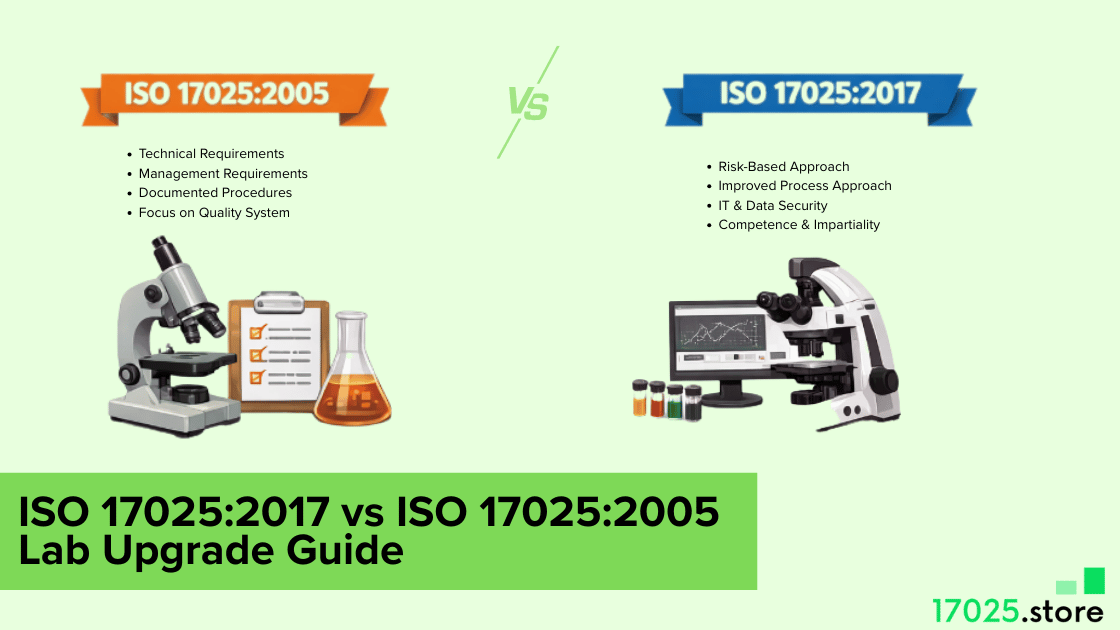
ISO 17025:2017 vs ISO 17025:2005 Lab Upgrade Guide

ISO 17025:2017 vs ISO 17025:2005 lab upgrade guide comparing key changes

ISO 17025:2017 vs ISO 17025:2005 is the shift labs actually feel during audits, not a simple rewrite. ISO/IEC 17025 is the competence standard for testing and calibration labs. This guide compares the 2005 and 2017 editions in lab terms, not clause jargon. You will see what truly changed, what audit evidence now needs to look like, and how to upgrade fast without rebuilding your whole system.

2005 focused on documented procedures. 2017 focuses on governance, risk control, and defensible reporting decisions. That single shift explains why audits now feel more like tracing a job trail than checking a manual.

A lab does not “pass” ISO 17025 by having more documents. A lab passes by producing results you can defend, with evidence that is retrievable, consistent, and impartial. That is why the 2017 revision matters in practice. Instead of rewarding procedure volume, it pushes outcomes, risk control, and traceable decision logic. The clean way to win audits is to compare what auditors accepted in 2005 with what they now try to break in 2017, then build evidence that survives stress.

Quick Comparison

Both editions still demand competent people, valid methods, controlled equipment, and technically sound results. What shifts is how the standard expects you to run the system and prove control.

Think of the key changes as three moves: tighter front-end governance, stronger operational risk control, and sharper reporting discipline. Digital record reality also gets treated as a real control area rather than “admin.”

2017 vs 2005: Structure Changes

In 2005, “Management” and “Technical” requirements. 2017 reorganizes requirements into an integrated flow that starts with governance and ends with results. This supports a clearer process approach, which makes audits feel like tracing a job through your system rather than checking whether a document exists.

What Changed In 2017

2017 is less interested in whether you wrote a procedure and more interested in whether your system prevents bad results under real variation.

Three shifts drive most audit outcomes. Governance comes first through impartiality and confidentiality controls. Risk-based thinking becomes embedded in how you plan and operate, instead of living as a preventive-action habit. Reporting becomes sharper when you state pass or fail, because decision logic must be defined and applied consistently.

Digital control is the silent driver behind many nonconformities. Information technology is no longer a side note because results, authorizations, calculations, and records typically live in LIMS, spreadsheets, instruments, and shared storage.

Minimum Upgrade Set: If you only strengthen one layer, strengthen the traceability of evidence. Make every reported result trace back to a controlled method version, authorized personnel, verified equipment status, and a reviewed record trail you can retrieve in minutes.

What Did Not Change

Core competence still wins. You still need technically valid methods, competent staff, calibrated and fit-for-purpose equipment, controlled environmental conditions where relevant, and results that can be traced and defended. The difference is that 2017 expects those controls to be provable through clean job trails and consistent decision-making, not just described in procedures.

Audit-Driving Differences

Most gaps show up when an auditor picks a completed report and walks backward through evidence. That single trail exposes what your system actually controls.

The fastest way to close real gaps is to design evidence around the failure modes auditors repeatedly uncover.

  • Impartiality is tested like a technical control, not a policy statement. Failure mode: a conflict exists, but no record shows it was assessed.
  • Risk-based thinking must appear where results can degrade, like contract review, method change, equipment downtime, and data handling. Failure mode: risk is logged generically, while operational risks stay unmanaged.
  • Option A and Option B must be declared and mapped so responsibilities do not split or vanish between systems. Failure mode: “ISO 9001 handles it,” it is said, but no mapped control exists.
  • Information technology integrity must be demonstrable across tools, including access, edits, backups, and review discipline. Failure mode: a spreadsheet changed, but no one can prove what changed and why.
  • Decision rule use must be consistent when you claim conformity, especially where uncertainty influences pass or fail. Failure mode: the same product passes one week and fails the next under the same rules.

ISO 17025:2017 vs ISO 17025:2005 Audit Impact Mini-Matrix

Area2005 Typical Pattern2017 Audit FocusEvidence That Closes It
GovernancePolicies existedImpartiality managed as a live riskImpartiality risk log + periodic review record
Risk ControlPreventive action mindsetRisk-based thinking embedded in operationsRisk entries tied to contract, method, data, equipment
Management SystemManual-driven complianceOption A vs Option B clarityDeclared model + responsibility mapping
Data SystemsForms and filesInformation technology integrityAccess control + change history + backup proof
ReportingResults issuedDecision rule consistencyDefined rule + review check + example application

Micro-Examples

A testing lab updates a method revision after a standard change. Under audit, the pressure point is not “did you update the SOP?” The pressure point is whether analysts were re-authorized for the new revision, whether worksheets and calculations match the revision, and whether report review confirms the correct method version was used. Failure mode: method changed, but authorization stayed old.

A calibration lab finds an overdue reference standard after a calibration was issued. Under audit, the expectation is an impact review: which jobs used the standard, whether results remain valid, whether re-issue or notification is required, and how recurrence is prevented through system control. Failure mode: the standard was overdue, but no traceable impact logic exists.

Evidence Pack Test

A fast way to compare your system against 2017 expectations is to run one repeatable test.

Pick one recently released report and trace the full evidence chain: request review, method selection, competence authorization, equipment status, environmental controls where relevant, calculations, technical review, and release. Then check whether impartiality and confidentiality were actually considered for that job and whether evidence is retrievable without “asking around.”

Use a measurable benchmark to keep this honest: if a report trail takes more than 3 minutes to retrieve, your system is not audit-ready. That is not a paperwork problem. It is a control design problem.

30-Day Upgrade Path

Speed comes from narrowing the scope. Upgrade what changes audit outcomes, then expand only if you need to.

  • Start with a small sample of recent reports across your highest-risk work, covering at least one case per method family.
  • Standardize job trail storage so the report links cleanly to method version, authorization, equipment status, and review evidence.
  • Embed risk-based thinking into contract review, method change, equipment failures, and data integrity controls.
  • Harden information technology control where results are created or stored, including access, edits, backups, and spreadsheet review.
  • Lock reporting discipline with a defined decision rule approach, then prove consistency through review records and examples.

After that month, any sampled report should be traceable in minutes, not hours. Once that capability exists, audits become predictable because your evidence behaves like a system.

FAQ

Is ISO 17025:2005 still used for accreditation?

Most accreditation and assessment expectations align with the 2017 edition. A lab operating on 2005-era habits will still be judged by 2017-style evidence and governance control.

What is the biggest difference between the editions?

Governance and effectiveness carry more weight, while document volume carries less weight. Results must be defensible through traceable job trails and consistent decision logic.

Do testing and calibration labs experience the changes differently?

System expectations stay the same, but calibration often feels more pressure on equipment status discipline, traceability chains, uncertainty use, and conformity statements.

Where do labs usually fail first in 2017 audits?

Common failures cluster around method version control, authorization by scope, data integrity in spreadsheets or LIMS, and inconsistent reporting decisions.

How should a small lab start without overbuilding?

Trace one report end-to-end, fix the evidence chain, then repeat with a small sample until retrieval and decision consistency are stable.

Conclusion

Treat ISO 17025:2017 vs ISO 17025:2005 as a shift in how you prove control, not a reason to generate more paperwork. Build job trails that survive report-trace audits, manage governance and risk where results can degrade, and lock reporting discipline so claims stay consistent under scrutiny. When evidence retrieval becomes fast and repeatable, the system becomes audit-ready by design rather than by effort.