
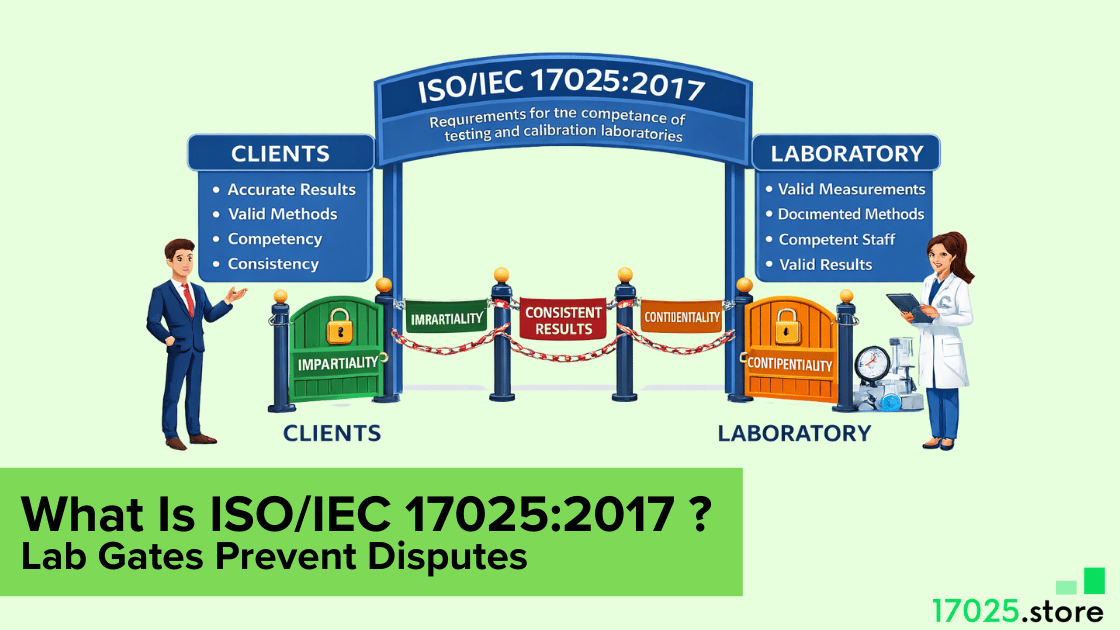
What Is ISO/IEC 17025:2017
Customer disputes start when results cannot be reconstructed. Regulators challenge labs when the scope is unclear. Product failures expose weak records and weak controls. ISO/IEC 17025:2017 exists for these moments. You will learn what the standard controls are, how accreditation decisions hold up, and which lab gates prevent avoidable findings.
Why Labs Ask What Is ISO 17025
Customer pressure often arrives after the report is issued. A complaint starts, then evidence is demanded. Confidence collapses when records do not link. Scope mismatch is a common trigger.
When teams ask What is ISO 17025 is, they want confidence in accuracy. They also want repeatability across operators and shifts. The standard answers that need controls. Those controls tie work to competence, methods, and records.
A lab can look organized and still be weak. The gap shows up in the traceability of decisions. Another gap shows up in the report statements. A third gap is uncontrolled method changes.
What It Controls In Daily Work
The standard rewards labs that control production, not paper. That means you control what you accept, what you do, and what you release. Control starts before the job begins. Control ends after the result is defended.
Weak labs rely on trust and memory. Strong labs rely on gates and records. Gates stop bad work early. Records let you defend good work later.
Control Gates That Prevent Bad Reports
| Control Gate | What Must Be True | What Breaks When It Fails |
| Contract Review | Method fit and scope fit are confirmed | Wrong method or out-of-scope work |
| Method Control | Verification or validation is triggered when needed | Results drift after changes |
| Equipment Status | Calibration and intermediate checks are enforced | Hidden equipment bias persists |
| Technical Records | Raw data, calculations, and review trail are linked | Results cannot be reconstructed |
| Validity Monitoring | Trends, checks, and PT or ILC are used | Drift stays invisible |
| Reporting | Required statements are present, and limits are clear | Reports mislead customers |
These gates are small, but they scale. They also match what assessors test. Most disputes map back to one failed gate.
Clause 7 Process Spine
Clause 7 is the process backbone in ISO/IEC 17025:2017.
- This is where labs win or fail.
- The spine defines the technical flow.
- It also defines what proof must exist.
7.1 Contract Review Control
7.2 Method Selection, Verification, Validation
7.3 Sampling, If Applicable
7.4 Handling Of Items
7.5 Technical Records
7.6 Uncertainty Evaluation, Where Relevant
7.7 Validity Monitoring
7.8 Reporting Requirements
7.9 Complaints
7.10 Nonconforming Work
7.11 Data And Information Management
Run this spine like a production line. Each step needs a trigger and a record. Each step needs ownership and review. Gaps compound across steps.
How ISO 17025 Accreditation Works
A report can be accepted or rejected on scope alone. Accreditation is not a general claim. It is a competence decision tied to scope. Scope defines what you can defend.
In ISO 17025 Accreditation, the scope is the deliverable. It ties methods to ranges and conditions. It also ties work to locations and limits. Customers should treat the scope as the contract.
Scope Match Check That Stops Disputes
1. Method Match: method ID and revision match the scope line.
2. Range Match: range and conditions stay inside scope limits.
3. Location Match: site and setup align with scope constraints.
4. Disclosure Match: deviations and limits are stated, not implied.
5. Status Match: equipment was in status on the job date.
These checks prevent late surprises. They also protect your lab’s reputation. Most disputes start with one mismatch.
Building ISO 17025 Compliance That Holds Up
Compliance fails when controls exist but do not connect. Labs lose time when evidence cannot be pulled fast. Customers lose trust when answers are slow. Assessors lose confidence when links are missing.
Strong ISO 17025 Compliance links people, methods, and records. The link must be job-specific. It must also be revision-specific. Otherwise, evidence becomes generic and weak.
A Lean Build Order That Stays Defensible
1. Competence Control: authorization, training, and periodic competence checks.
2. Method Control: method selection rules and change triggers.
3. Equipment Control: status rules and intermediate checks logic.
4. Record Control: raw data protection and calculation traceability.
5. Validity Control: trending, checks, and comparison discipline.
Build these before expanding routines. Improvements work only when controls exist. Reviews work only when the data is reliable. That is how the system stays stable.
FAQs
1. What Is ISO/IEC 17025:2017?
ISO/IEC 17025:2017 is the international standard that sets requirements for competence, impartiality, and consistent operation of testing and calibration laboratories, so they produce valid results for a defined scope and can demonstrate traceability and technical control when challenged.
2. Who benefits most from this standard?
Testing and calibration labs benefit most. Labs under regulation benefit even more. Any lab facing disputes benefits quickly.
3. Is documentation enough for a strong system?
Documentation is necessary, but never sufficient. Practice must match the document. Records must prove practice on each job.
4. What creates the biggest risk in real labs?
Scope mismatch is a fast failure mode. Method changes without proof are another. Uncontrolled data handling is a third.
5. What should a defensible report allow?
A defensible report should allow result reconstruction.
It should show the method and conditions used. It should also show limits and disclosures
6. How do you keep results reliable over time?
Use validity monitoring and trend checks. Use comparisons when suitable. Act on drift before customers see it.
Conclusion
ISO/IEC 17025 lives where labs get challenged. Disputes, failures, and scope questions expose weak control. The win comes from running the work like production. Control what you accept, what you perform, and what you release.
Use the Clause 7 spine as your technical skeleton. Build control gates to prevent preventable failures. Add scope match checks to prevent disputes. When these pieces hold, confidence follows. Your results stay defensible, even under pressure.