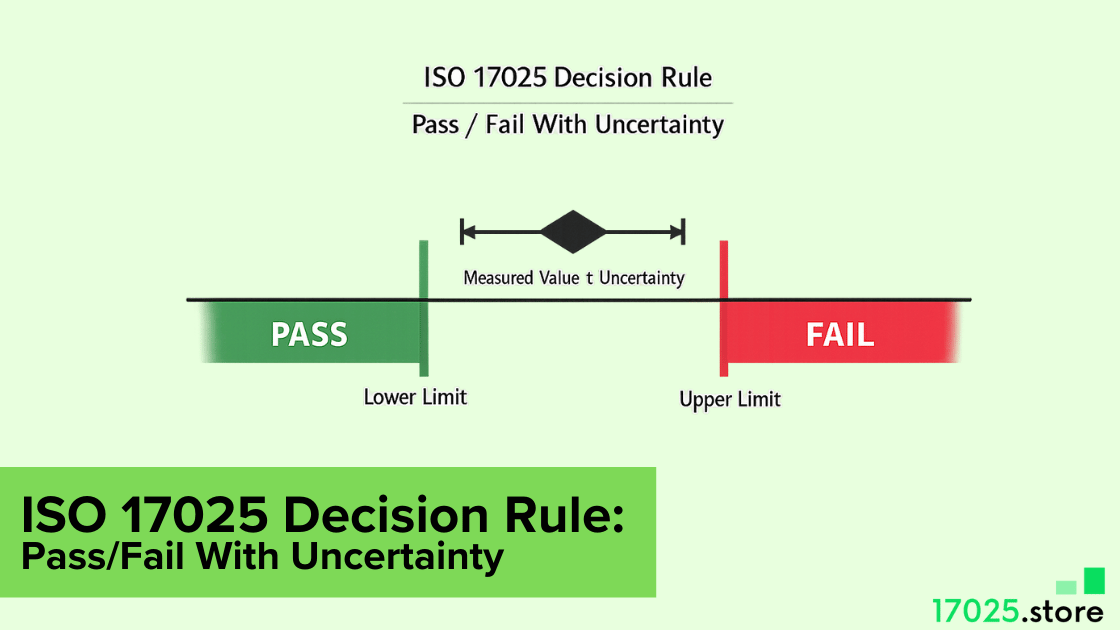
A decision rule decides how you declare pass or fail when uncertainty exists. This page explains how to choose an ISO/IEC 17025 decision rule, agree on it during contract review, and report it cleanly. You also get clause-linked tables you can reuse in your procedure and on certificates.
Labs do not lose audits because uncertainty exists. They lose audits because the rule is unclear, the customer did not agree, or the report language cannot be defended. In practice, you need one rule that fits the job, then a repeatable way to apply it every time you issue a conformity call.
Decision Rules In ISO/IEC 17025
Definition: This is the rule your lab uses to convert a measured value plus its uncertainty into a compliance decision against a stated limit.
Application: Start by fixing three inputs during contract review. You need the specification limit, the uncertainty you will report at that point, and the style of conformity call you will issue. When the product standard already defines the rule, the lab uses that rule and records it as the agreed basis.
Where teams go wrong is mixing rules. They declare one line item pass using measured value only, then tighten decisions on another line item using a safety margin. That inconsistency is the first thing customers and auditors challenge.
Clause Table
Clause
Purpose
Lab Document
Entry To Include
Record Location
7.1.3
Agreement on the decision basis before work starts
Contract Review Procedure / Quote Template
Decision method, uncertainty basis used for the call, and boundary handling for borderline results
Quote file, contract review record, or job order notes
7.8.6
Reporting conformity calls with a clear scope
Report Template / Reporting Procedure
Conformity claim, the requirement used, and the results the claim covers
Report body plus controlled template revision history
Statement Of Conformity
Definition: A statement of conformity is the plain-language claim on a report or certificate that an item meets, or does not meet, a stated requirement.
Application: Decide which reporting style you will use, and keep it consistent across the job and across time.
Option A is a direct acceptance rule. You compare the result to the tolerance limit and declare pass or fail. It is fast, but borderline results carry a higher decision risk.
Option B is a guarded acceptance rule. You shrink the acceptance zone by a safety margin, so “pass” is only issued when the result is clearly inside the limit after uncertainty is considered. It reduces false accept risk, but it can increase false rejects near the limit.
Certificate-Ready Lines
“Conformity is evaluated against [specification] using the agreed decision rule; the claim applies to results listed in [table or section].”
“For this job, pass is reported only when the result, including expanded uncertainty,y remains within the acceptance limit.”
“Results in the boundary zone are reported as inconclusive and are not declared compliant or noncompliant.”
Guard Band
Definition: A guard band is the safety margin between the tolerance limit and the acceptance limit that your lab actually uses for the decision.
Application: Treat it as an engineering knob you set, not a sentence you copy. If you want conservative decisions, increase the margin. If the customer accepts more risk, reduce it.
Use a defined acceptance limit (AL) derived from the tolerance limit (TL) and a chosen margin g for an upper limit case:
AL = TL − g
Then use the measured value x and expanded uncertainty U.
Case
Rule Using x and U
Decision
Risk Control
Clear Pass
x + U ≤ AL
Pass
Controls false accept risk
Clear Fail
x − U > TL
Fail
Controls false reject ambiguity
Boundary Zone
Otherwise
Inconclusive
Forces documented handling of borderline results
Pass/Fail Table
Use this table to keep the decision rule consistent across quote, execution, and reporting.
Process Point
Inputs Set
Records Kept
Decision Output
Report Text
Contract Review
Limit, uncertainty basis, decision style
Spec revision, agreed rule, boundary handling
Rule agreed, or job declined
The decision basis is recorded in the job acceptance
Test Or Calibration
Data quality and uncertainty evaluation method
Result x, expanded uncertainty U, limit TL, acceptance limit AL
Pass, fail, or inconclusive
Decision for each result line item
Report Release
Scope of claim and coverage of results
Item IDs, units, and points included in the claim
The same logic applies to all points
One consistent claim line plus scope
Complaint Or Appeal
Boundary-zone handling
Review notes, allowed recheck actions, and approvals
Confirm, revise, or withdraw
Traceable change record
When you implement the ISO/IEC 17025 decision rule this way, you are not just compliant. You are predictable, which customers actually pay for.
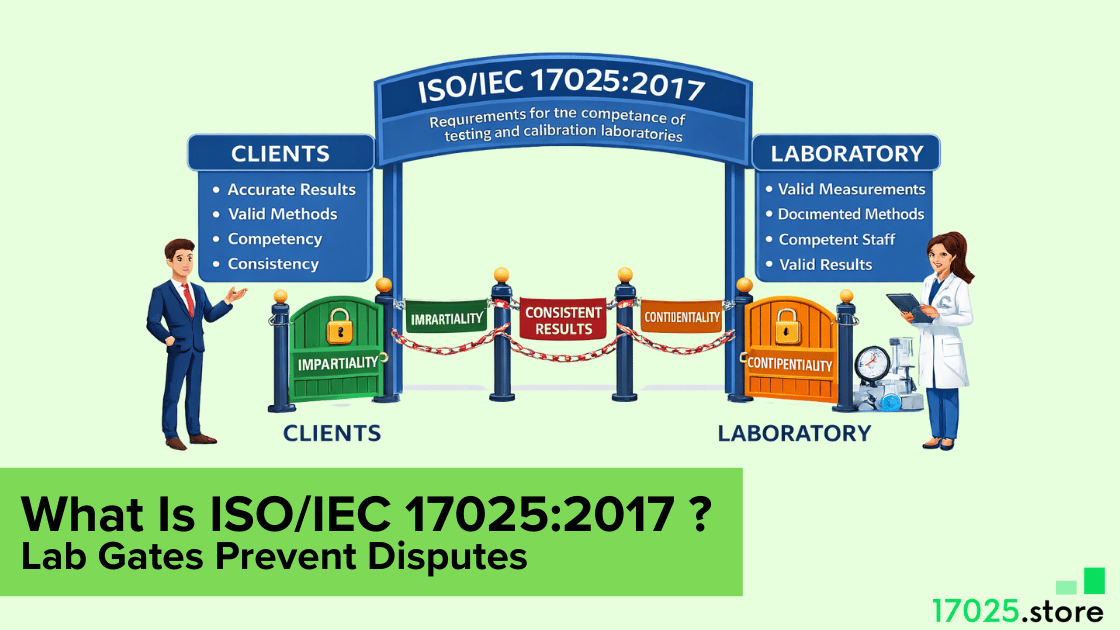
Customer disputes start when results cannot be reconstructed. Regulators challenge labs when the scope is unclear. Product failures expose weak records and weak controls. ISO/IEC 17025:2017 exists for these moments. You will learn what the standard controls are, how accreditation decisions hold up, and which lab gates prevent avoidable findings.
Why Labs Ask What Is ISO 17025
Customer pressure often arrives after the report is issued. A complaint starts, then evidence is demanded. Confidence collapses when records do not link. Scope mismatch is a common trigger.
When teams ask What is ISO 17025 is, they want confidence in accuracy. They also want repeatability across operators and shifts. The standard answers that need controls. Those controls tie work to competence, methods, and records.
A lab can look organized and still be weak. The gap shows up in the traceability of decisions. Another gap shows up in the report statements. A third gap is uncontrolled method changes.
What It Controls In Daily Work
The standard rewards labs that control production, not paper. That means you control what you accept, what you do, and what you release. Control starts before the job begins. Control ends after the result is defended.
Weak labs rely on trust and memory. Strong labs rely on gates and records. Gates stop bad work early. Records let you defend good work later.
Control Gates That Prevent Bad Reports
Control Gate
What Must Be True
What Breaks When It Fails
Contract Review
Method fit and scope fit are confirmed
Wrong method or out-of-scope work
Method Control
Verification or validation is triggered when needed
Results drift after changes
Equipment Status
Calibration and intermediate checks are enforced
Hidden equipment bias persists
Technical Records
Raw data, calculations, and review trail are linked
Results cannot be reconstructed
Validity Monitoring
Trends, checks, and PT or ILC are used
Drift stays invisible
Reporting
Required statements are present, and limits are clear
Reports mislead customers
These gates are small, but they scale. They also match what assessors test. Most disputes map back to one failed gate.
Clause 7 Process Spine
Clause 7 is the process backbone in ISO/IEC 17025:2017.
This is where labs win or fail.
The spine defines the technical flow.
It also defines what proof must exist.
7.1 Contract Review Control
7.2 Method Selection, Verification, Validation
7.3 Sampling, If Applicable
7.4 Handling Of Items
7.5 Technical Records
7.6 Uncertainty Evaluation, Where Relevant
7.7 Validity Monitoring
7.8 Reporting Requirements
7.9 Complaints
7.10 Nonconforming Work
7.11 Data And Information Management
Run this spine like a production line. Each step needs a trigger and a record. Each step needs ownership and review. Gaps compound across steps.
How ISO 17025 Accreditation Works
A report can be accepted or rejected on scope alone. Accreditation is not a general claim. It is a competence decision tied to scope. Scope defines what you can defend.
In ISO 17025 Accreditation, the scope is the deliverable. It ties methods to ranges and conditions. It also ties work to locations and limits. Customers should treat the scope as the contract.
Scope Match Check That Stops Disputes
1. Method Match: method ID and revision match the scope line. 2. Range Match: range and conditions stay inside scope limits. 3. Location Match: site and setup align with scope constraints. 4. Disclosure Match: deviations and limits are stated, not implied. 5. Status Match: equipment was in status on the job date.
These checks prevent late surprises. They also protect your lab’s reputation. Most disputes start with one mismatch.
Building ISO 17025 Compliance That Holds Up
Compliance fails when controls exist but do not connect. Labs lose time when evidence cannot be pulled fast. Customers lose trust when answers are slow. Assessors lose confidence when links are missing.
Strong ISO 17025 Compliance links people, methods, and records. The link must be job-specific. It must also be revision-specific. Otherwise, evidence becomes generic and weak.
A Lean Build Order That Stays Defensible
1. Competence Control: authorization, training, and periodic competence checks. 2. Method Control: method selection rules and change triggers. 3. Equipment Control: status rules and intermediate checks logic. 4. Record Control: raw data protection and calculation traceability. 5. Validity Control: trending, checks, and comparison discipline.
Build these before expanding routines. Improvements work only when controls exist. Reviews work only when the data is reliable. That is how the system stays stable.
FAQs
1. What Is ISO/IEC 17025:2017?
ISO/IEC 17025:2017 is the international standard that sets requirements for competence, impartiality, and consistent operation of testing and calibration laboratories, so they produce valid results for a defined scope and can demonstrate traceability and technical control when challenged.
2. Who benefits most from this standard?
Testing and calibration labs benefit most. Labs under regulation benefit even more. Any lab facing disputes benefits quickly.
3. Is documentation enough for a strong system?
Documentation is necessary, but never sufficient. Practice must match the document. Records must prove practice on each job.
4. What creates the biggest risk in real labs?
Scope mismatch is a fast failure mode. Method changes without proof are another. Uncontrolled data handling is a third.
5. What should a defensible report allow?
A defensible report should allow result reconstruction.
It should show the method and conditions used. It should also show limits and disclosures
6. How do you keep results reliable over time?
Use validity monitoring and trend checks. Use comparisons when suitable. Act on drift before customers see it.
Conclusion
ISO/IEC 17025 lives where labs get challenged. Disputes, failures, and scope questions expose weak control. The win comes from running the work like production. Control what you accept, what you perform, and what you release.
Use the Clause 7 spine as your technical skeleton. Build control gates to prevent preventable failures. Add scope match checks to prevent disputes. When these pieces hold, confidence follows. Your results stay defensible, even under pressure.
Metrological traceability is the documented link between a reported value and a recognized reference, with stated uncertainty through an unbroken comparison chain. This guide shows how to verify Calibration and Traceability in under five minutes using certificate gates and scope checks. You will leave with a pass fail rule and a one-page checklist.
What Traceability Means
Traceability is not a logo, and it is not a promise. In real lab work, it is a chain you can defend under questioning. The chain starts at your reported result, travels through identified standards and comparisons, and ends at a recognized reference to SI units.
A strong chain has three properties that matter on the floor. The standards are uniquely identified and controlled. The comparison path is unbroken, so each link points to the next. The uncertainty is stated in a usable waybecause uncertainty is the payload that travels with the chain.
One practical definition helps you act fast: you can show what standard was used, prove it was valid on the job date, and explain how uncertainty supports the decision you made. When any one of these fails, the record becomes paperwork instead of proof.
Why Traceability Protects Decisions
Most teams only “feel” traceability after a complaint, an audit question, or a product escape. A disciplined proof gate prevents that, because it forces the measurement system to justify the decision, not just produce a number.
Here are the decisions that quietly depend on traceability, even in routine work:
Release or hold product based on a tolerance decision.
Accept or reject supplier data during incoming checks.
Sign a report with confidence that the review questions can be answered.
Investigate drift without guessing whether the tool or the method moved.
Good systems make these decisions repeatable. Another engineer should be able to take the same certificate and reach the same conclusion, with no hidden steps and no private knowledge.
How NIST Traceable Calibration Claims Should Read
A NIST Traceable Calibration claim should be treated as shorthand, not as a guarantee by a third party. The burden is on the calibration provider and the user to ensure the certificate content actually supports the traceability statement.
Proof lives in specifics, not in the phrase. The certificate should identify the calibrated item, show measured results, list the standards used by ID, and state uncertainty in a way you can use. When those elements are missing, the wording becomes hard to defend, even if the lab is reputable.
Keep your internal rule simple: accept the claim only when the certificate makes the chain auditable from your result back to controlled references, with uncertainty attached.
When Accredited Calibration Is Worth It
Accredited Calibration is worth paying for when risk is high and tolerance is tight because it adds competence oversight and defined capability boundaries. The boundary that matters is the scope, since scope tells you what ranges and uncertainties the provider is competent to deliver.
Accreditation still does not replace your acceptance gate. A certificate can be accredited and still be wrong for your use if the range is mismatched, the method is not aligned with your needs, or the uncertainty does not support your tolerance decision.
Treat accreditation as a trust amplifier, then apply the same technical proof checks you apply to any other certificate.
Calibration and Traceability Certificate Proof Gate
If you want one rule that works in every lab, use this: if you cannot connect the result to controlled standards with stated uncertainty, you cannot defend the decision.
Use the table below as your pass fail gate. It is intentionally short, so it gets used.
Certificate Item
Quick Check
Reject Or Escalate If
Asset Identity + Date
Asset ID or serial and calibration date match the item used
Wrong ID, missing date, or unclear identification
Results + As Found As Left
Measured results are shown, and as found and as left appear when the adjustment occurred
Only “pass” language, missing points, or adjustment not disclosed
Method Or Procedure ID
Method ID is listed, and the issue or revision date is not newer than the calibration date
No method ID or revision timing is inconsistent
Standards Used
Reference standards are listed by ID and are controlled on the job date
Standards not listed, IDs do not match, or status cannot be proven
Uncertainty Expanded
Expanded uncertainty is stated and usable for your tolerance decision
Uncertainty missing, unclear, or not comparable to tolerance
Scope Match For Accredited
If accredited, the work is inside the provider’s scope for range and capability
Out of scope range or parameter, or the scope cannot be confirmed
Authorization + Certificate ID
Unique certificate ID and authorized sign-off are present
No unique ID or missing authorization
Coverage Factor k, in Four Lines
Expanded uncertainty is commonly reported as (U = k \cdot u_c). k is the coverage factor used to scale the combined standard uncertainty. If k is missing, ask what confidence level the uncertainty represents. For tight tolerances, treat missing k as a decision risk, not a detail.
Worked Micro Example, Certificate Driven
Tolerance: ±0.020 mm Expanded uncertainty on certificate: ±0.015 mm Decision margin: 0.020 − 0.015 = 0.005 mm
That last line is the point. A small margin means you are one drift event away from a wrong call, even if the instrument “passed.”
To verify fast without growing the workflow, run this triage every time:
Confirm identity and results match what you used.
Confirm uncertainty and k are decision usable.
Confirm standards, method ID, and scope alignment.
1. Traceable Vs Accredited: What Is The Real Difference?
Traceable means the result can be linked through controlled comparisons with uncertainty stated. Accredited means competence oversight exists, and the scope defines the capability. One supports the technical claim, the other strengthens governance.
2. Does an NIST Claim Automatically Mean ISO IEC 17025 Compliance?
No. The phrase alone is not proof. Compliance and confidence come from the certificate content, the provider’s system, and whether the scope, method control, and uncertainty support your use case.
3. Can Traceability Exist Without Uncertainty Shown?
A traceability statement without usable uncertainty is rarely decision-ready. You need uncertainty to judge fitness for tolerance and risk, not just to satisfy documentation.
4. What Should I Check First When Time Is Tight?
Start with identity plus results, then uncertainty, then standards used. When those three are weak, deeper reading rarely fixes the outcome.
5. How Do I Set Recalibration Frequency Without Guessing?
Base it on risk and evidence. Use drift history, usage severity, tolerance to uncertainty margin, and the consequences of a wrong decision. Tighten intervals when the margin is thin, then relax only after trend data supports it.
Conclusion
Traceability stops being a paperwork burden when you treat it as a release gate. Use a short certificate proof table, enforce scope match, and keep uncertainty decision focused. When this discipline is consistent, Calibration and Traceability become something you can prove quickly and defend calmly.
Metrological traceability is not a certificate collection exercise. It is a technical proof that the reported result links to a stated reference through a documented route, with uncertainty that travels with that route. This guide shows how to build that proof, check it fast, and write a statement that holds up to review and audit.
Labs usually lose traceability arguments for simple reasons. The reported point is unclear, the chain is valid on paper but not on the job date, or uncertainty is claimed but not actually supported by the route used. Once you fix those three, the page stops being theory and becomes a repeatable control.
Metrological Traceability Definition
Metrological Traceability is the property of a measurement result where the result can be related to a stated reference through a documented, unbroken calibration route, with stated uncertainty at each link. The claim is about the result you reported, not only about the instrument you used. This difference matters because audits are run on job records, not on equipment folders.
Result Vs Instrument
An instrument can be calibrated and still produce results that are not defensible for a specific job. The result depends on how the instrument was used, the range employed, the corrections applied, and the conditions controlled. Traceability is proven when the report value can be reconstructed from the route evidence with the same assumptions.
A clean test is simple. Pick one reported number and ask whether you can show the route, the uncertainty basis, and the validity on that job date in under a few minutes. If that answer is shaky, the issue is not effort. The issue is linkage.
What “Calibrated” Does Not Prove
Calibration alone does not prove your result is valid at the reported point. A certificate may not cover the range used, may state uncertainty that does not apply to your method, or may require conditions you did not meet. A certificate also does not prove that intermediate checks were acceptable between calibrations.
Most failures appear when “calibrated” is treated as a blanket word. A more defensible habit is to treat calibration as one link, then force the job record to show what else held the result together.
What ISO 17025 Expects From Traceability
ISO 17025 expects a traceability route that matches your scope, your uncertainty model, and your decision rule. The most audit-proof approach is to make your report statement precise, then ensure your records support it. A strong wording pattern is a traceability statement that names the measurand, names the reference, and names the route evidence IDs.
A reliable format is: result, reference, route, and uncertainty. When that structure is consistent, reviewers stop rewriting reports and start verifying evidence.
When “Traceable To SI” Is Not Possible
Some measurements cannot be practically linked to SI in the way people casually write it. In those cases, the fix is not to soften wording. The fix is to explicitly state the reference you used and why it is technically valid for that measurand.
Use a stated reference that is specific, such as a certified reference material value, a consensus reference standard, or a customer-agreed reference with documented limits. Then state the route to that reference and the uncertainty attached to it. If you can prove that chain, the claim is defensible even when traceable to SI, which is not the right statement.
Coverage Factor k
Uncertainty should not be written as decoration. It must be supported by the route and used consistently with your decision rule.
Expanded uncertainty U, coverage factor k means you take a standard uncertainty and multiply by k to get an interval intended to cover a large fraction of values that could reasonably be attributed to the measurand. Many labs use k near 2 for an approximately 95% coverage in routine cases, but k should follow your method, your model, and any required distribution assumptions.
Build The Traceability Chain Without Gaps
A traceability chain is a calibration hierarchy that you can point to and defend on the job date. The chain starts at the reported result, then moves through the measuring system, then through the working standard, then up to a higher standard, and finally to the stated reference authority. Every link must carry uncertainty that is applicable to the range and method used.
Place the following decision visual in this section, right after the first paragraph, because it helps readers understand the hierarchy at a glance and improves recall.
Decision Visual (Insert As Diagram Image Or Monospace Block) Alt text: Result to SI traceability chain diagram
Reported Result
|
Instrument / System Used
|
Working Standard
|
Higher Standard
|
Reference Authority (NMI or Stated Reference)
|
Stated Reference (SI or Defined Reference)
[Gate Before Claiming Traceable]
Route exists + Uncertainty applies + Job date valid + Records link cleanly
What Must Travel With Each Link
The chain becomes audit-proof when the same minimum fields travel with every link. That stops “we have it somewhere” discussions and forces every claim to be testable at the record level.
Field To Carry
What You Record
Why It Matters
Measurand At Reported Point
Quantity, unit, point, or range, conditions
Prevents point ambiguity
Reference Type
SI or stated reference
Forces an explicit claim
Route Summary
Link names and IDs
Makes the chain readable
Uncertainty Basis
Model and applicable range
Prevents mismatch claims
Validity On Job Date
Interval status and checks
Proves time validity
Evidence IDs
Certificate and check record IDs
Enables fast retrieval
Metrological Traceability Example
The purpose of examples is proof logic, not storytelling. Each example below includes a compact micro case line so the route feels real and reviewable.
Mass Example
A mass result is defensible when the balance, the working weights, and the acceptance logic are linked to the reported point. The report value should be tied to the specific balance ID, the check weight set ID, and the method that defineswarm-upp, stabilization, and any correction model used.
Micro case: daily check uses a 200 g check weight, acceptance is ±2 mg, and a fail triggers stop use, investigation, and a documented impact review on jobs since last pass.
Temperature Example
A temperature result is defensible when the reference probe route is clear, and the comparison conditions match the assumptions behind that route. Immersion, stabilization, gradients, and placement are not side notes. They are part of whether the comparison is technically valid.
Micro case: at 100 °C, stabilize for 10 minutes, confirm block gradient within 0.2 °C, and accept the comparison only when reference and test probe readings are stable within your method limit.
The 4-Question Pass Gate Before You Claim Traceable
This gate prevents most weak claims from reaching a report. It also makes internal review faster because it converts vague confidence into checkable answers.
Pass Gate Questions
Is the measurand defined at the reported point, including conditions that affect the result
Is the reference explicit, either SI or a stated reference that is defensible
Does uncertainty apply to the range and method used, and does it follow the route of evidence?
Is the chain valid on the job date, including interval status and intermediate checks
If one answer is “no,” do not patch the wording. Fix the route, fix the checks, or narrow the claim to what you can prove.
Minimum Records Auditors Pull First
Auditors usually start with one report and then test whether your system can retrieve proof without guessing. When records exist but do not link cleanly to the job ID, discussions get long and trust drops.
Evidence Pack Map
Equipment register record showing ID, range used, interval, and status on the job date
Calibration certificate IDs for the instrument and the standards used in the route
Intermediate check record IDs, including acceptance criteria and result, not only “OK.”
Method and calculation version used for corrections and uncertainty, with review approval
Environmental condition record when it materially affects the measurand or uncertainty
Review and release the trail tying the reported value to the evidence IDs above.
Metrological Traceability FAQs
1) What is traceability in simple words?
It means your reported result can be linked to a stated reference through a documented route, and the uncertainty that supports that route is stated and applicable.
2) Is traceability about the instrument or the result?
It is about the result. Instruments support the route, but the claim must hold for the specific reported number and its conditions.
3) What is Metrological Traceability in ISO 17025 terms?
It is the ability to show an unbroken reference route for a reported result, with stated uncertainty at each step, valid on the job date, and backed by retrievable records.
4) What do I write when SI traceability is not possible?
State the reference you used, explain why it is technically valid, and show the route and uncertainty tied to that stated reference.
5) What is the fastest way to avoid weak traceability claims?
Use the 4-question pass gate during review and require evidence IDs in the report workfile before release.
Conclusion
Traceability becomes easy when you treat it as result-proven engineering. Define the measurand at the reported point, make the reference claim explicit, ensure uncertainty is supported by the route, and prove validity on the job date. Once those are stable, your traceability statement reads cleanly and holds under pressure.
A practical next step is to standardize the link fields in one template, enforce the pass gate in review, and store evidence IDs in a single “evidence pack” location per job. That turns traceability from a debate into a controlled routine.
We use cookies to ensure that we give you the best experience on our website. If you continue to use this site we will assume that you are happy with it.